
Governing Claude Code with Azure API Management: Per-Developer Budgets, Tiering and Chargeback on Microsoft Foundry
Hand Claude Code to a whole team without giving anyone a model credential. An Azure API Management AI gateway in front of Foundry gives per-developer token budgets, Entra ID group tiering, 429 throttling and per-person chargeback. Step-by-step, with a one-command accelerator.
Running Claude Code on Foundry
solves the credential problem for one developer: az login and you’re in, no API key anywhere.
Scaling that to a team surfaces a different problem. Going direct to Foundry means every
developer needs Cognitive Services User on the resource, and that gives you no rate limit, no
budget, no tiering, and usage data only at the resource level — you can see that $4,000 of tokens
were spent, but not by whom.
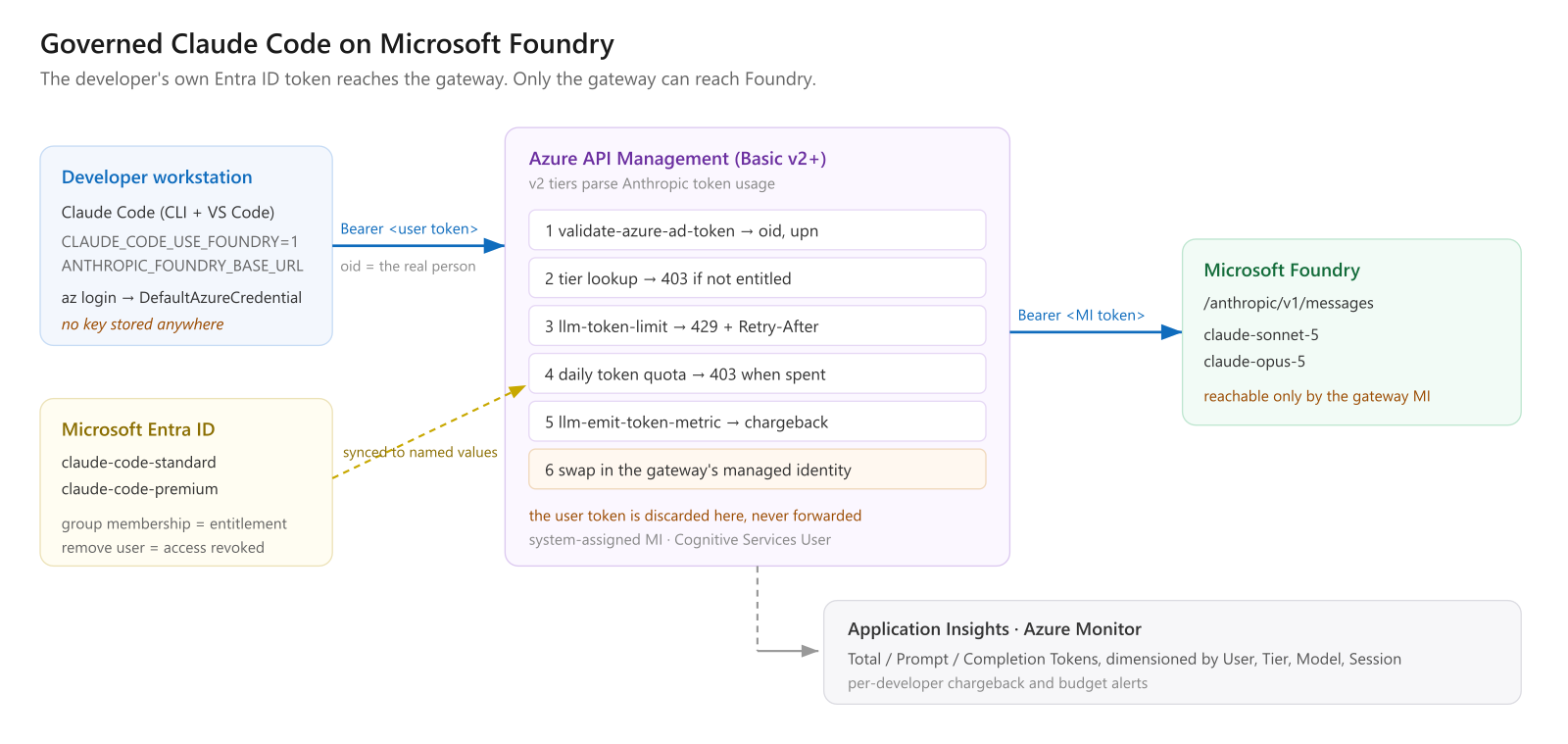
This post puts an Azure API Management AI gateway in front. Developers end up holding no Foundry role at all.
Everything below was built and executed on 13 Aug 2026: APIM Basic v2, Claude Code
v2.1.223, claude-sonnet-5 and claude-opus-5 in East US 2.
Skip the manual steps: the whole thing is packaged as a one-command accelerator — github.com/naveenneog/claude-code-foundry-gateway. Steps 1–7 below are what it automates, and worth reading before you run it.
What you get
| Control | Mechanism | Result |
|---|---|---|
| Who may use Claude Code | Entra ID group membership | 403 with an actionable message |
| Tiered budgets | llm-token-limit per tier |
standard vs premium |
| Per-developer rate limit | tokens/minute keyed on oid |
429 + Retry-After |
| Per-developer daily budget | token-quota + period |
403 until reset |
| Runaway-agent protection | rate-limit-by-key |
request ceiling |
| Chargeback | llm-emit-token-metric |
tokens per named person |
| No credential sprawl | gateway managed identity | nothing to leak or rotate |
Why per-developer metering actually works here
This is the load-bearing detail, and I established it by intercepting real traffic rather than assuming.
Claude Code’s Foundry mode does not invent a credential. It calls the Azure SDK’s
DefaultAzureCredential, so the request carries the developer’s own Entra ID token:
{
  "aud": "https://cognitiveservices.azure.com",
  "oid": "43cc5304-...",
  "upn": "naveen.g@contoso.com",
  "appid": "04b07795-8ddb-461a-bbee-02f9e1bf7b46"
}
Three consequences:
- Identity is unforgeable.
oidis signed by Entra. A developer cannot spoof a colleague, and a shared credential cannot exist because there is no credential to share. - No client-side auth work. No app registration, no custom audience, no device-code flow.
- Offboarding is free. Remove the person from the group and access stops. Nothing is revoked at the endpoint.
Claude Code also sends an x-claude-code-session-id header, which makes a useful metric
dimension.
Step 1 — Deploy the gateway
The SKU decision matters more than anything else in this post. APIM’s llm-* policies parse
the Anthropic Messages API shape only on v2 tiers. On classic Developer/Basic/Standard/
Premium the policies apply happily and count zero tokens forever — budgets never trip and you
believe you are governed when you are not.
az apim create has no v2 support, so deploy with ARM/Bicep:
az deployment group create -g rg-claude-gateway `
    --template-file infra/main.bicep `
    --parameters foundryAccountName=<foundry> publisherEmail=<you@contoso.com>
Basic v2 provisions in about four minutes; classic tiers take 30–45.
The template enables a system-assigned managed identity — the identity that will reach Foundry.
Step 2 — Let the gateway in, and nobody else
$apimMi = az apim show -n <apim> -g <rg> --query identity.principalId -o tsv
$scope  = az cognitiveservices account show -n <foundry> -g <rg> --query id -o tsv

az role assignment create `
    --assignee-object-id $apimMi --assignee-principal-type ServicePrincipal `
    --role "Cognitive Services User" --scope $scope
Then the step that actually closes the bypass:
az role assignment delete --assignee <developer-oid> `
    --role "Cognitive Services User" --scope $scope
Until developers lose that role they can point Claude Code straight at Foundry and skip every control below. Leave it assigned only to the gateway.
Step 3 — Entitlement lives in Entra ID
az ad group create --display-name claude-code-standard --mail-nickname claude-code-standard
az ad group create --display-name claude-code-premium  --mail-nickname claude-code-premium
Entitlement belongs in Entra because that is where joiner/mover/leaver already runs. Adding
someone to claude-code-premium is an action your identity team can take, audit and review —
whereas an allowlist in a config file drifts and is nobody’s job.
Step 4 — Import Foundry as an API
az apim api create -g <rg> --service-name <apim> `
    --api-id claude-foundry --path claude `
    --service-url "https://<foundry>.services.ai.azure.com/anthropic" `
    --protocols https --subscription-required false

az apim api operation create -g <rg> --service-name <apim> `
    --api-id claude-foundry --operation-id messages `
    --display-name "Create Message" --method POST --url-template "/v1/messages"
--subscription-required false is deliberate: authorization comes from the Entra token, not an
APIM subscription key. Claude Code has no reliable way to send a custom key header, and a shared
key would destroy per-person attribution anyway.
Step 5 — The policy
Limits live in named values so changing a budget is a config edit, not a redeployment:
tpm-standard=20000   quota-standard=500000
tpm-premium=80000    quota-premium=5000000
calls-per-minute=120
The policy itself, in order:
<validate-azure-ad-token tenant-id="{{tenant-id}}" output-token-variable-name="jwt"
                         failed-validation-httpcode="401">
    <audiences>
        <audience>https://cognitiveservices.azure.com</audience>
    </audiences>
</validate-azure-ad-token>

<set-variable name="userId" value="@(((Jwt)context.Variables["jwt"]).Claims.GetValueOrDefault("oid",""))" />

<set-variable name="tier" value="@{
    var oid = "," + (string)context.Variables["userId"] + ",";
    if (("{{allow-premium}}").Contains(oid))  { return "premium"; }
    if (("{{allow-standard}}").Contains(oid)) { return "standard"; }
    return "denied";
}" />

<llm-token-limit counter-key="@((string)context.Variables["userId"])"
                 tokens-per-minute="{{tpm-standard}}" estimate-prompt-tokens="false"
                 retry-after-header-name="Retry-After"
                 remaining-tokens-header-name="x-ratelimit-remaining-tokens"
                 tokens-consumed-header-name="x-tokens-consumed" />

<llm-emit-token-metric namespace="claudecode">
    <dimension name="User" value="@((string)context.Variables["userUpn"])" />
    <dimension name="Tier" value="@((string)context.Variables["tier"])" />
</llm-emit-token-metric>

<authentication-managed-identity resource="https://cognitiveservices.azure.com"
                                 output-token-variable-name="msi-token" />
<set-header name="Authorization" exists-action="override">
    <value>@("Bearer " + (string)context.Variables["msi-token"])</value>
</set-header>
Four things worth knowing:
- The audience is
https://cognitiveservices.azure.com— that is what Claude Code requests a token for, so that is what the gateway must accept. No app registration required. estimate-prompt-tokens="false"bills actual usage from the response.- XML comments cannot contain
--. APIM rejects the policy with an error that never mentions comments. - The developer’s token is discarded, not forwarded. Foundry sees only the gateway identity.
Sentinel commas around each object id in the allowlists make contains() exact, so one id cannot
partially match another.
Step 6 — Sync group membership
The gateway cannot read group membership from the caller’s token: the Cognitive Services audience
is a first-party Microsoft resource whose token has no configurable groups claim. Two options:
| How | Trade-off | |
|---|---|---|
| Sync (default) | a script writes object ids into named values | no tenant admin needed; membership lags by one sync |
| Live Graph lookup | policy calls Graph per request, cached | no lag; needs admin consent for GroupMember.Read.All |
I hit Authorization_RequestDenied on the Graph grant — it needs a Privileged Role Administrator
— so the accelerator ships the sync approach and documents the Graph upgrade.
./scripts/Sync-ClaudeAccess.ps1 -ApimName <apim> -ResourceGroup <rg>
Service principals in a group are invisible to a delegated token without Application.Read.All,
so CI identities are passed explicitly with -AdditionalPremiumOids.
Step 7 — Chargeback telemetry
Two settings, both of which fail silently if you miss them:
- the APIM diagnostic needs
metrics: true, orllm-emit-token-metricemits nothing and the metric namespace never appears - Application Insights needs
CustomMetricsOptedInType: WithDimensions, or the metric arrives as a bare total with noUserbreakdown — exactly the part chargeback needs
Then:
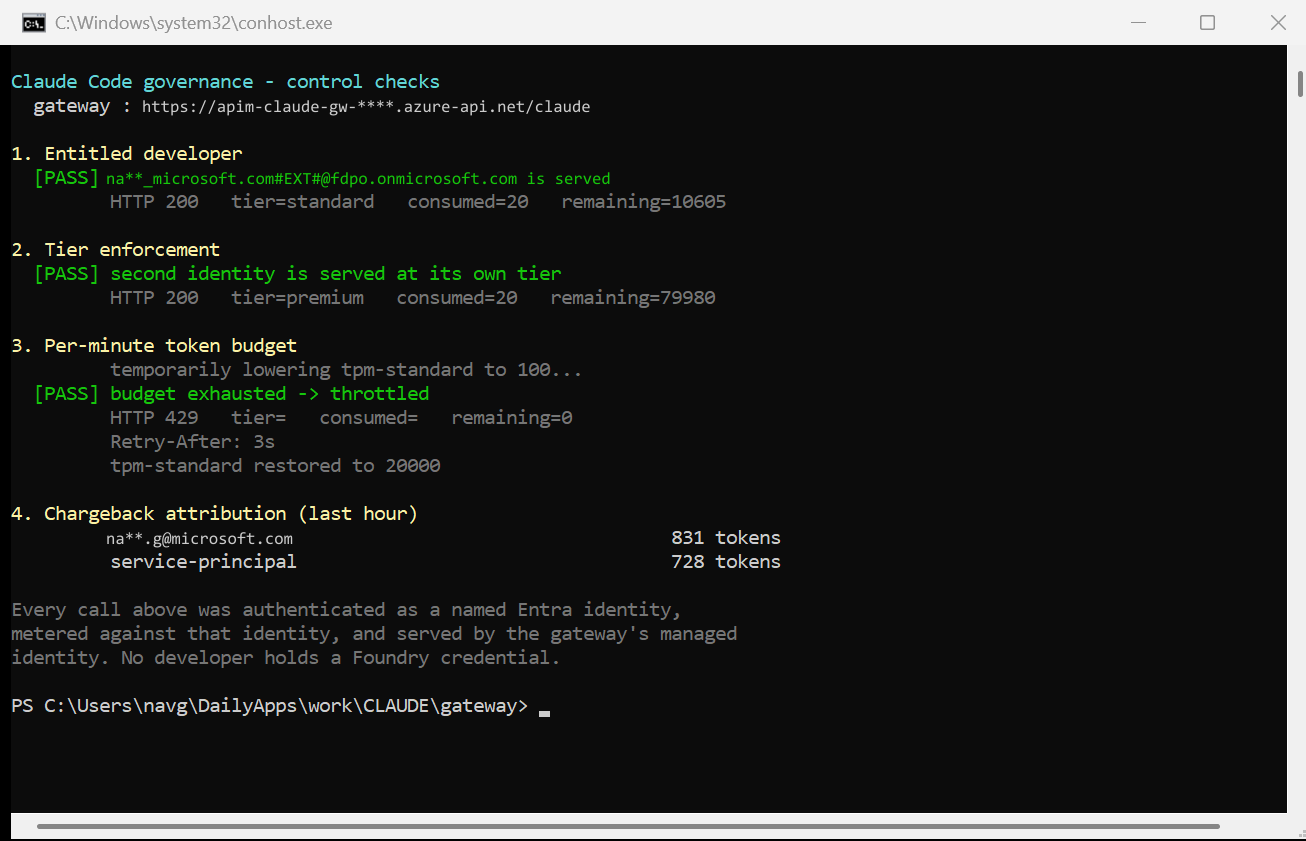
naveen.g@contoso.com      831 tokens
service-principal         728 tokens
The Azure CLI’s
az monitor metrics listdrops--namespacefor custom namespaces and reports “metric not found”. Query the REST API instead.
Step 8 — Point Claude Code at the gateway
{
  "env": {
    "CLAUDE_CODE_USE_FOUNDRY": "1",
    "ANTHROPIC_FOUNDRY_BASE_URL": "https://<apim>.azure-api.net/claude",
    "ANTHROPIC_DEFAULT_SONNET_MODEL": "claude-sonnet-5",
    "ANTHROPIC_DEFAULT_OPUS_MODEL": "claude-opus-5",
    "ANTHROPIC_DEFAULT_HAIKU_MODEL": "claude-sonnet-5"
  },
  "availableModels": ["claude-sonnet-5", "claude-opus-5"],
  "enforceAvailableModels": true
}
ANTHROPIC_FOUNDRY_BASE_URLandANTHROPIC_FOUNDRY_RESOURCEare mutually exclusive. Setting both fails withbaseURL and resource are mutually exclusive. Drop the resource variable when you move to the gateway.
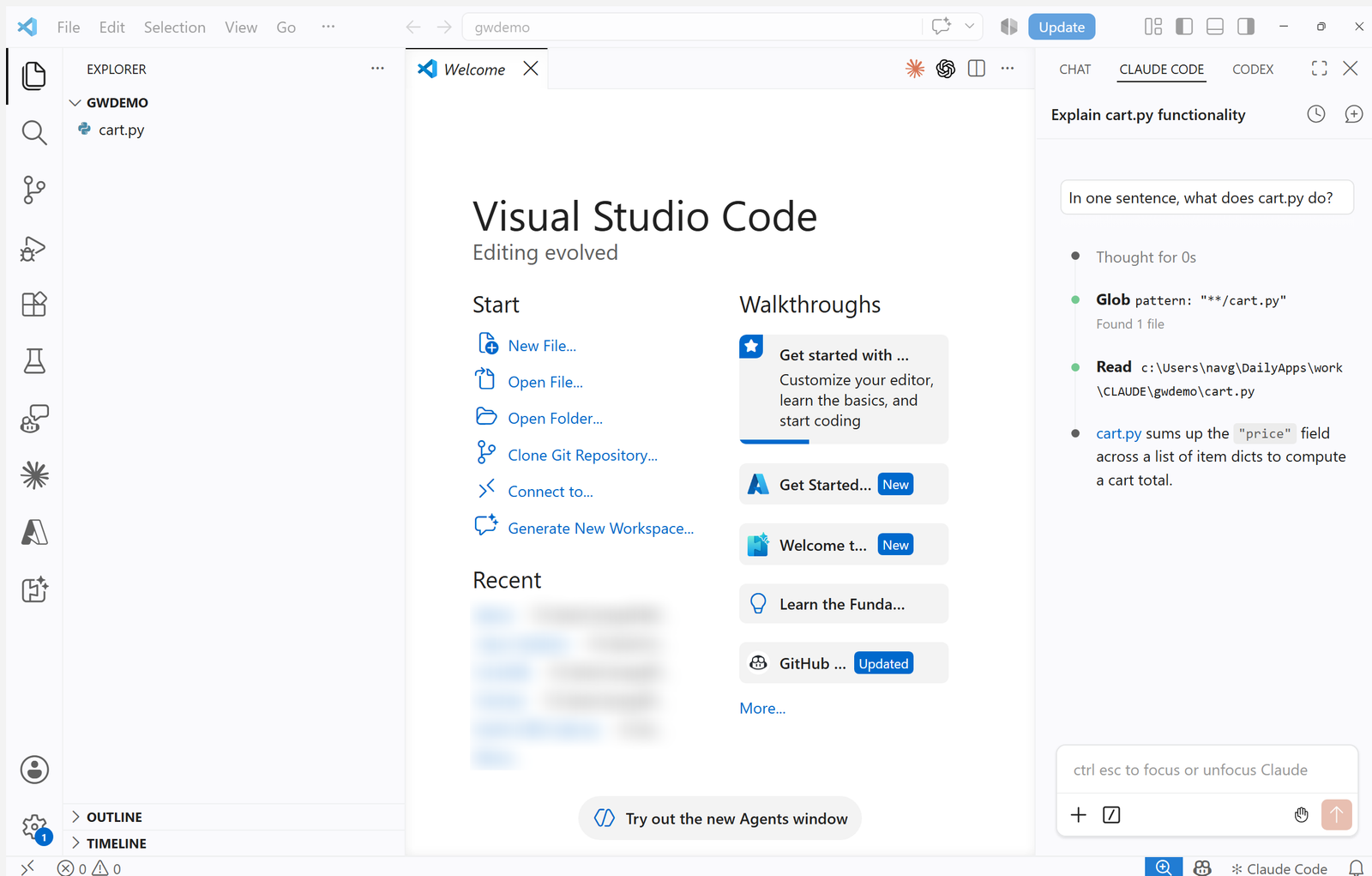
That one file covers the CLI and the VS Code extension. The panel opens straight into a usable prompt — no sign-in step, because the Entra credential is already resolved — and streaming works through the gateway unchanged:
To stop developers editing their own settings, push the same JSON as managed settings:
HKLM\SOFTWARE\Policies\ClaudeCode via Intune or Group Policy on Windows,
/Library/Application Support/ClaudeCode/managed-settings.json on macOS,
/etc/claude-code/managed-settings.json on Linux. Those also let you force availableModels and
block bypassPermissions.
Onboarding a developer, end to end
az ad group member add --group claude-code-standard `
    --member-id (az ad user show --id alice@contoso.com --query id -o tsv)

./scripts/Sync-ClaudeAccess.ps1 -ApimName <apim> -ResourceGroup <rg>
Alice then runs az login, drops in the settings file, and works. No key, no Foundry role, and
she appears in chargeback from her first request.
Guests: a B2B guest (a
#EXT#UPN) must useaz login --tenant <tenant-id>. A plainaz loginlands them in their home tenant and the gateway returns 401. This caught me out onboarding a colleague.
The accelerator
All of the above is packaged as a solution accelerator:
github.com/naveenneog/claude-code-foundry-gateway
git clone https://github.com/naveenneog/claude-code-foundry-gateway
cd claude-code-foundry-gateway
az login
./deploy.ps1
With no arguments it discovers a Foundry account that has Claude deployments, maps the
sonnet/opus/haiku aliases to deployments that actually exist, deploys APIM + Log Analytics +
Application Insights, creates the API and policy, grants the gateway identity its role, creates
the Entra groups, syncs membership, and writes the settings.json you hand to developers.
./deploy.ps1 -WhatIf previews without changing anything. There is a Deploy to Azure button
for the portal path, Show-Governance.ps1 to verify all four controls, and an inspector proxy
that shows exactly what Claude Code sends — that is how the identity model above was established
rather than assumed.
What it costs
| Item | Approx |
|---|---|
| APIM Basic v2, 1 unit | ~$250/month |
| Log Analytics + App Insights | ingestion-based, small at this volume |
| Claude tokens | Foundry CCU billing, unchanged by the gateway |
Basic v2 is the cheapest tier that can enforce Anthropic token budgets at all. If that is too much for a pilot, run direct-to-Foundry first and add the gateway when a second team joins.
The honest summary
The gateway buys you four things that direct access cannot: entitlement, budgets, throttling and attribution. It costs you an APIM instance and one more hop.
For a single developer that trade is not worth it. For a team — especially one where “who spent the $4,000?” is a question someone will eventually ask — it is the difference between a tool you can roll out and a tool you have to keep explaining.
The part I did not expect: none of it required changing how developers work. They still run
az login and claude. The governance is entirely on the platform side.
- 💻 Accelerator: https://github.com/naveenneog/claude-code-foundry-gateway
- 📘 Getting Claude Code on Foundry first: step-by-step setup
- 📗 Microsoft Learn — APIM
llm-token-limit: https://learn.microsoft.com/en-us/azure/api-management/llm-token-limit-policy - 📗 Microsoft Learn —
llm-emit-token-metric: https://learn.microsoft.com/en-us/azure/api-management/llm-emit-token-metric-policy