
Cast in Bidri Metal: Four Ancient Karnataka Board Games, Reborn in 3D
Four traditional Karnataka board games — Saalu Mane Ata, Aadu Huli, Chowka Bara and Alaguli Mane — rebuilt as free, offline, Kannada-first 3D games, each dressed in a hand-designed Bidri metalwork world modelled on the blackened-silver craft of Bidar. Here's the history, the artisan-matching art pipeline, and the whole build story.
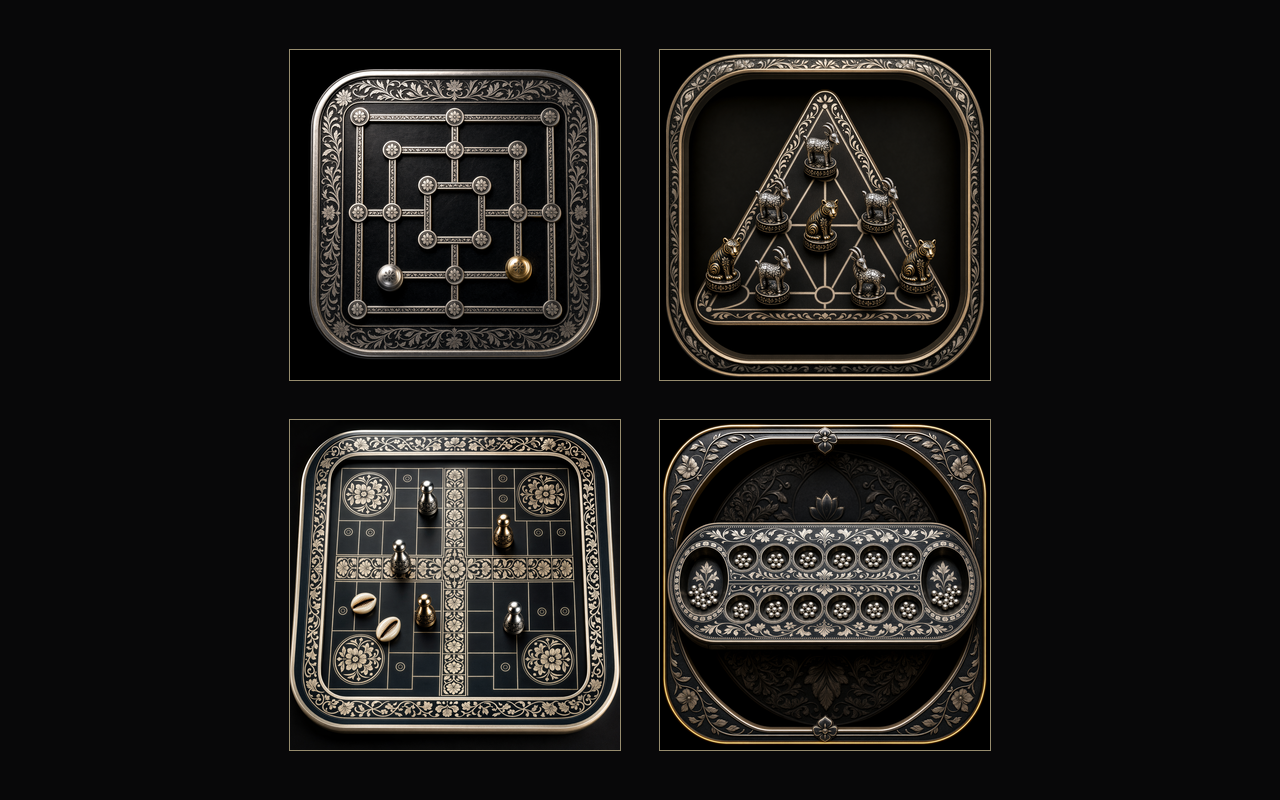
Before Ludo, before Snakes & Ladders left the subcontinent and came back Anglicised, our grandmothers drew boards in rice-flour on the courtyard floor and played games older than most kingdoms. This is an attempt to give four of Karnataka’s own games a home that honours where they came from — and looks good enough to keep on your phone.
I’m Naveen Gopalakrishna — an AI Global Black Belt at Microsoft, a compulsive builder after hours. This #AI4Good build is four games shipped together, each its own free web app and Android APK:
| Game | What it is | Play | Get the APK |
|---|---|---|---|
| ಸಾಲು ಮನೆ ಆಟ · Saalu Mane Ata | Nine Men’s Morris — align three, break one | play ▶ | APK |
| ಆಡು ಹುಲಿ · Aadu Huli | Goats & Tigers — the asymmetric hunt | play ▶ | APK |
| ಚೌಕಾ ಬಾರಾ · Chowka Bara | The cowrie-and-tokens race | play ▶ | APK |
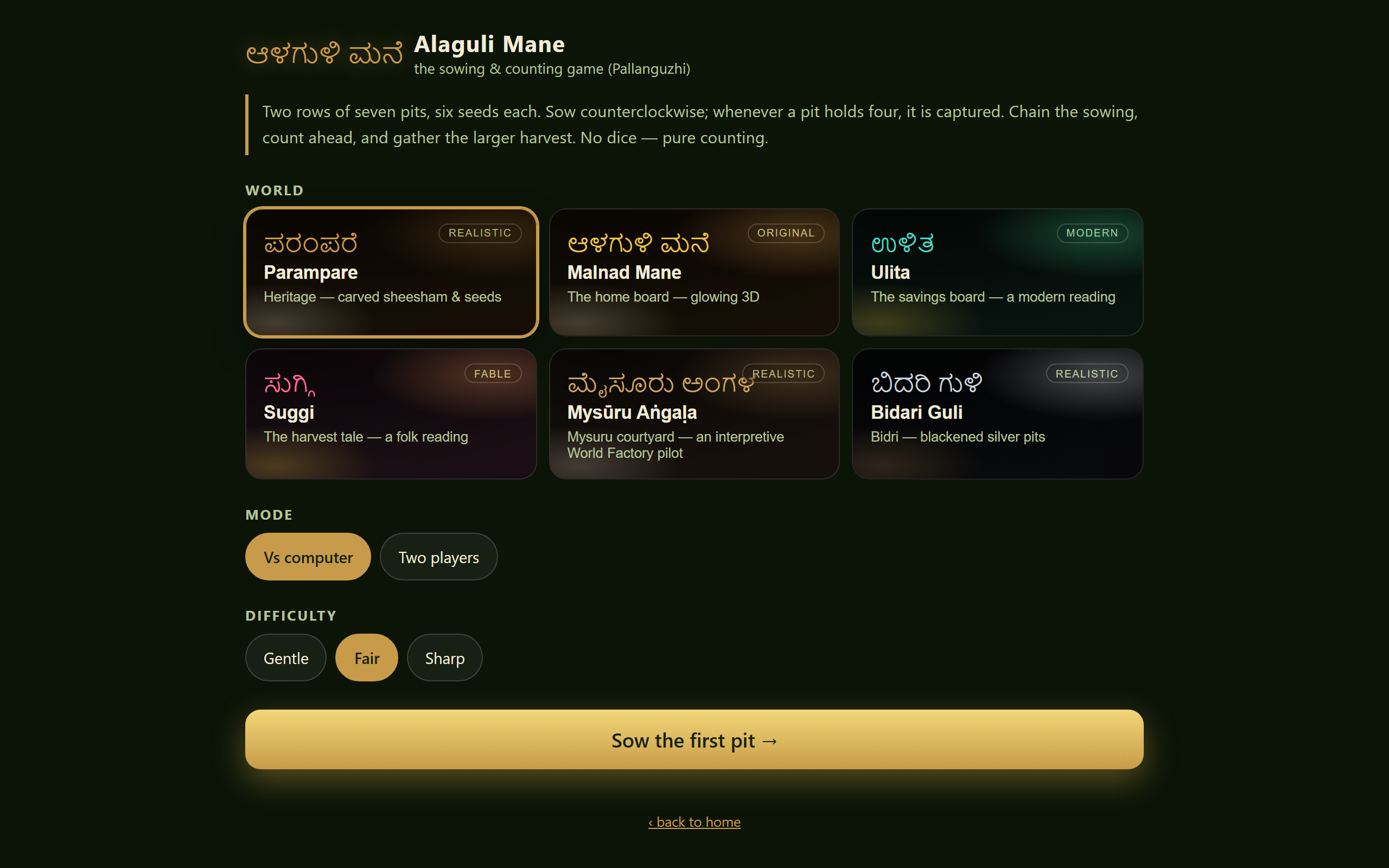
| ಅಳಗುಳಿ ಮನೆ · Alaguli Mane | Pallanguzhi — the sowing & counting game | play ▶ | APK |
The games, and where they come from
None of these are inventions. They’re games with centuries — sometimes millennia — of continuous play across South India.
- Saalu Mane Ata (ನವಕಂಕರಿ / Nine Men’s Morris) is a mill game — three nested squares, nine seeds a side. Form a connected line of three (“a mill”) and you break one of your rival’s seeds. It’s pure strategy, no dice: the same family of game whose boards are scratched into the stone floors of temples at Aihole and into the plinths of countless choultries. A game of foresight.
- Aadu Huli (Goats & Tigers) is an asymmetric hunt on a triangular board — a few tigers try to leap and capture the goats, while a herd of goats tries to hem the tigers in until they cannot move. Two players, wildly different jobs. It’s the South Indian cousin of Bagh-Chal.
- Chowka Bara (ಚೌಕಾಬಾರಾ / Ashta Chamma) is a race game played with cowrie shells for dice on a cross-and-circle board, with safe squares where you cannot be cut. The ancestor Ludo forgot.
- Alaguli Mane (Pallanguzhi) is a mancala — two rows of pits, seeds sown counter-clockwise, pits of four captured. No dice, no luck: just counting far enough ahead. The carved wooden alaguli mane board is a genuine heirloom object in Kannada and Tamil homes.
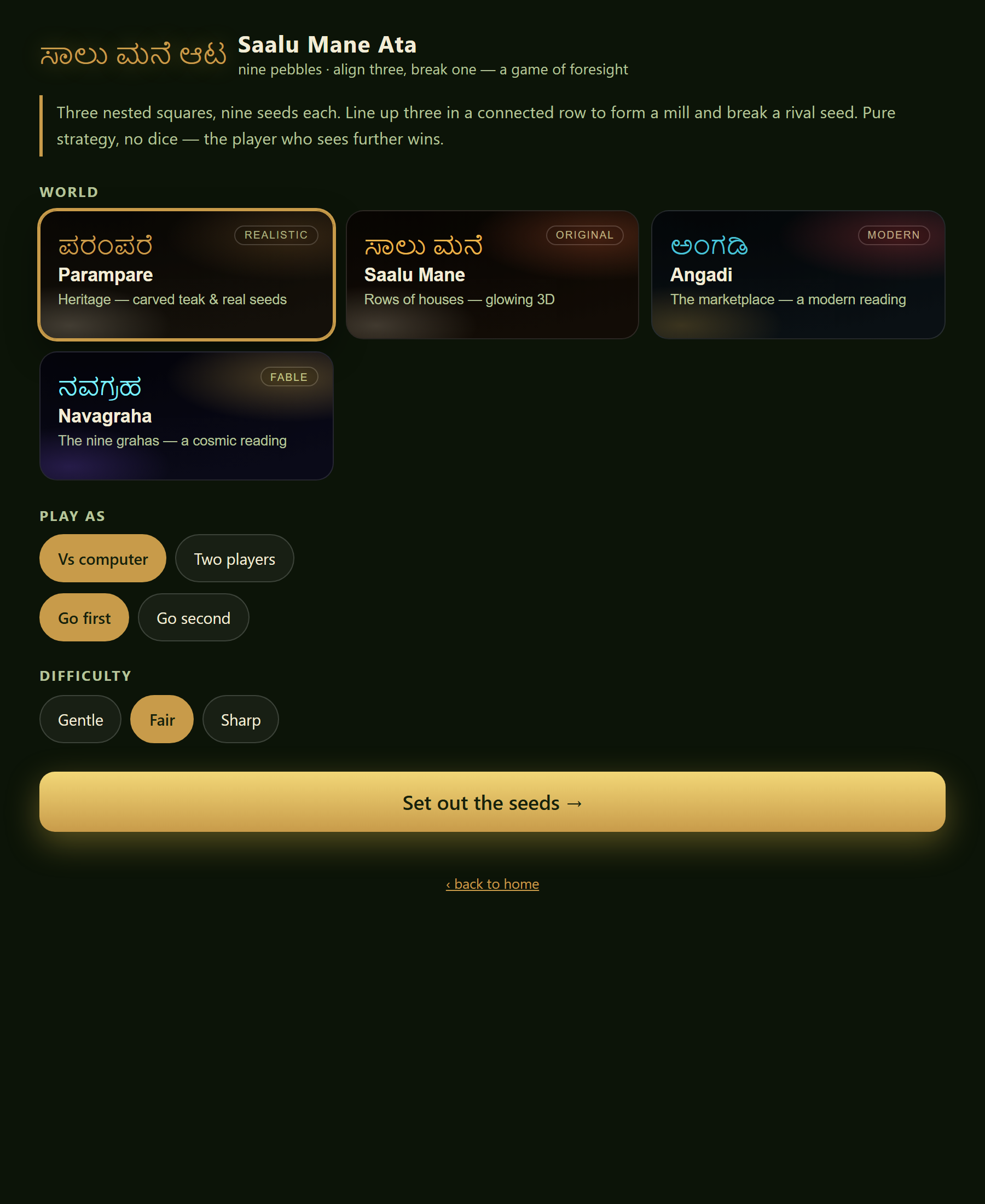
Each game ships with multiple “worlds” — a Realistic heritage board (carved teak, real seeds), an Original glowing-3D reading, a Modern interpretation, sometimes a Fable world — and the one this post is really about.
The Bidri world — the reason this build exists
The spark for the whole project was a single question: what would these games look like if a master craftsman of Bidar made them?
Bidriware (ಬಿದರಿ) is a 14th-century metal craft from Bidar, Karnataka. A zinc-and-copper alloy is cast, engraved with floral and geometric tarkashi patterns, inlaid with pure silver wire, and then — the signature move — the whole surface is blackened with a special soil from the Bidar fort, a soil that darkens the alloy to a deep matte black but leaves the silver untouched and brilliant. The result is unmistakable: jet-black metal, glowing silver inlay. A GI-tagged craft, and one of the most striking in the world.
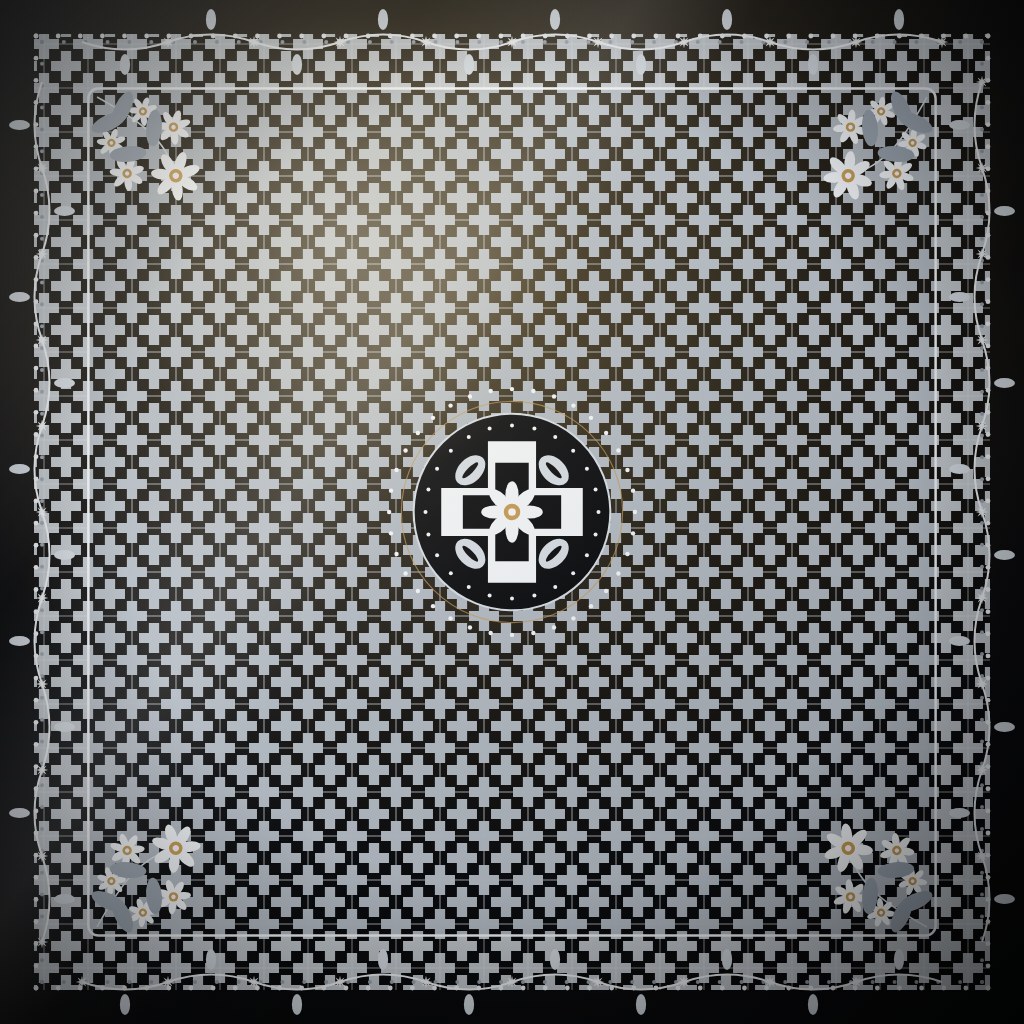
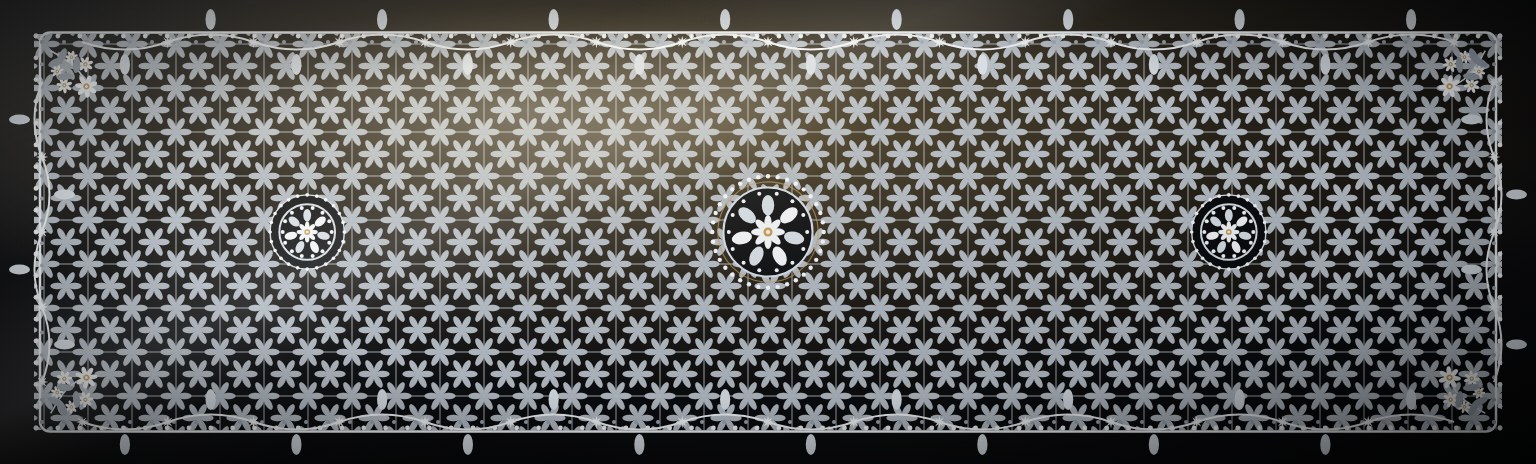
So every game got a bespoke Bidri board — not a generic skin, but a mat whose inlay is designed around that game’s geometry:
| The board, cast in Bidri | |
|---|---|
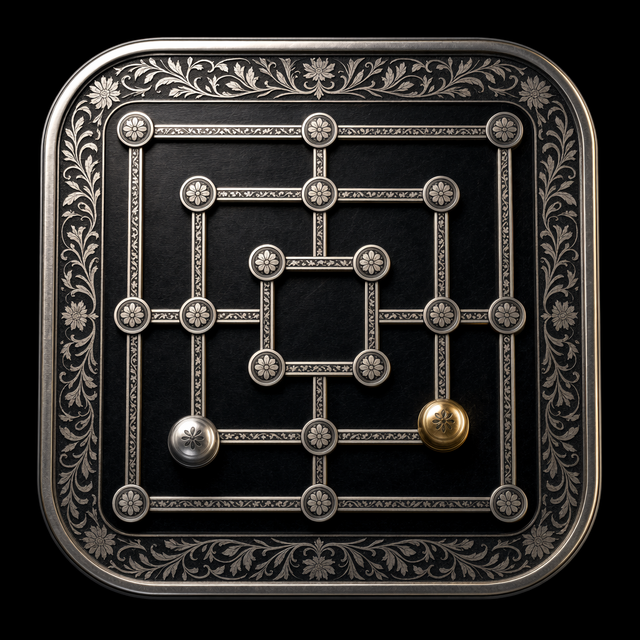
| Saalu Mane Ata | Three concentric silver-inlaid squares, floral rosette nodes at every point. |
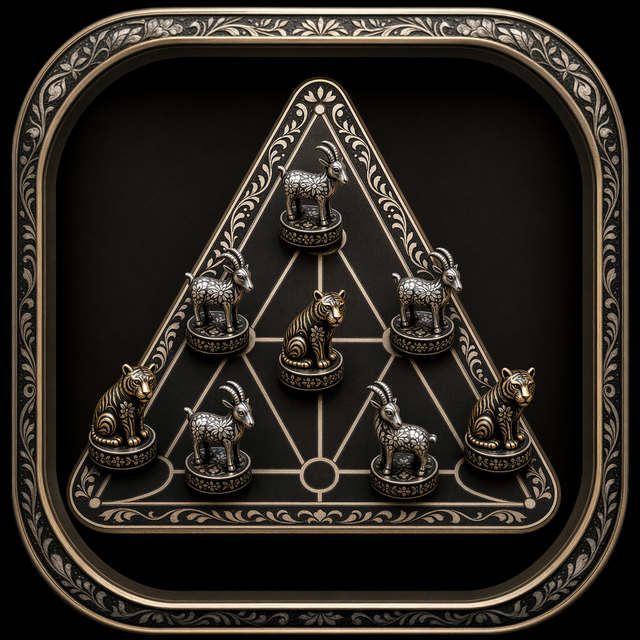
| Aadu Huli | A triangular hunt-lattice with cast brass tigers and silver goats on the points. |
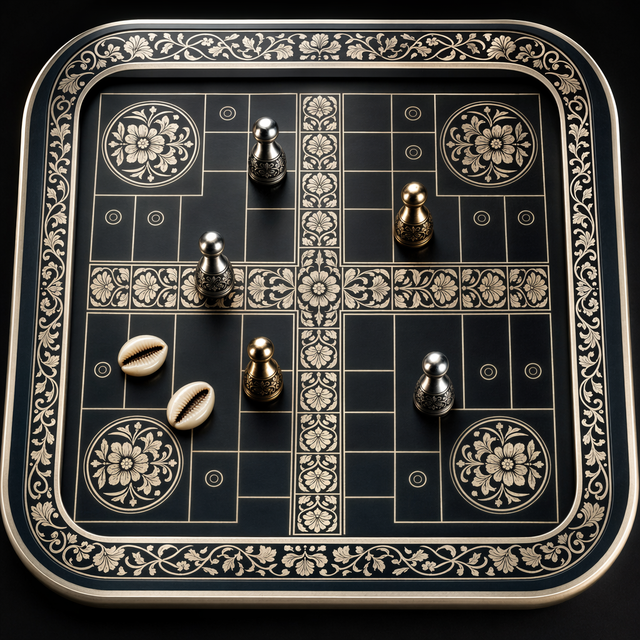
| Chowka Bara | A cross-and-circle race board, corner rosettes, cowries resting in the field. |
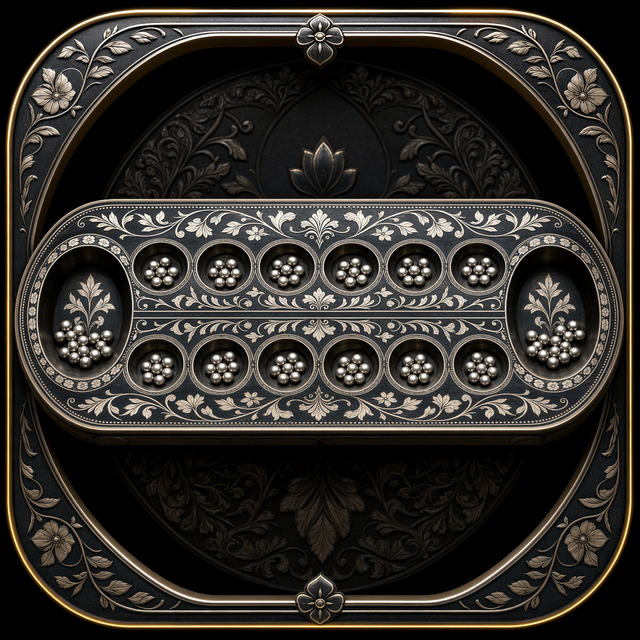
| Alaguli Mane | A two-row sowing tray, each pit ringed in silver tarkashi, seeds nested inside. |
How we matched real artisan work
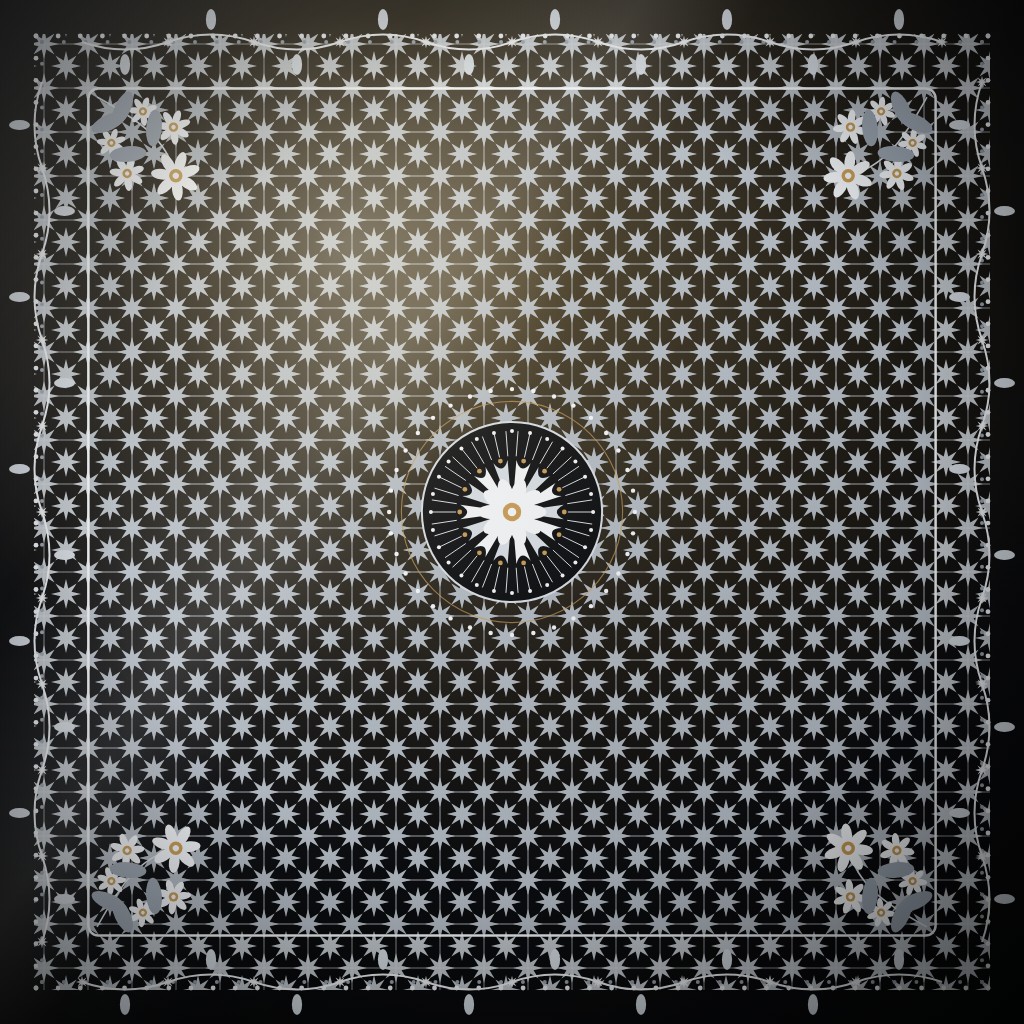
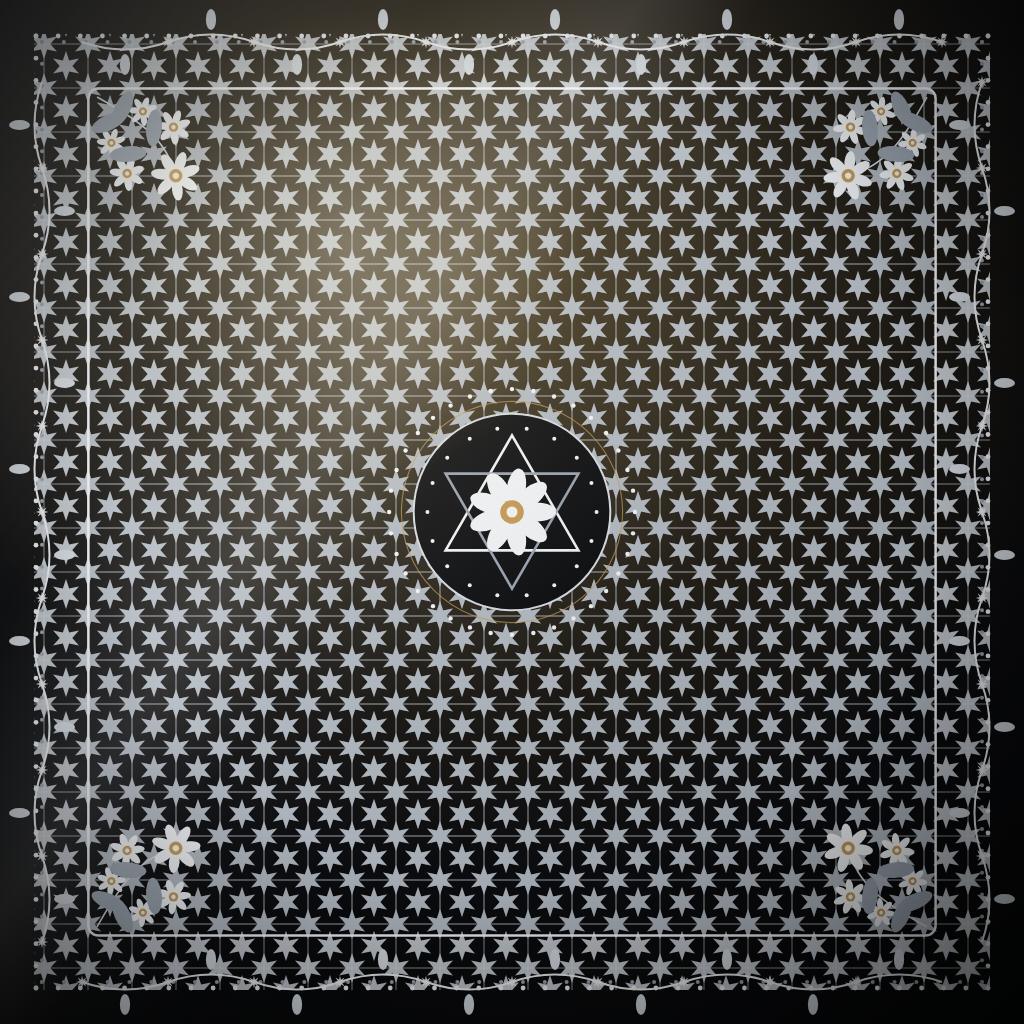
Getting AI-generated art to actually read as Bidri — and not as “generic ornate black-and-gold” — took a tight loop:
- Study first. Real Bidri is matte black, not glossy, the inlay is silver, not gold, the motifs are floral tarkashi and geometric bands, and the craft lives in the contrast — bright metal against dead-black ground. Those became hard constraints, not suggestions.
- Prompt to the constraints. Every render was pushed toward “near-black blackened-brass ground, brilliant pure-silver inlay, delicate floral tarkashi engraving, museum-quality metalwork, soft studio light with rich reflections” using Azure
gpt-image-2. Gold was allowed only as a thin rim highlight — the way a real piece catches light on its edge. - Align the board to the mat. The generated ornament had to sit around the playable geometry, not fight it — the central design centred on the board, the surrounding tarkashi filling the field, the way a craftsman composes a real tray. The mat and a seamless table tile were rendered as a set so the world extends past the board.
- Iterate on light & reflection. Several passes were spent purely on how the silver catches light and how the black holds shadow, until each board looked like a photographed object rather than a texture.
The same pipeline produced each game’s app icon — this game’s own board, cast in Bidri, as the launcher art:
The Bidri work was distilled into a reusable “Bidri style” skill so the look can be reproduced consistently across future builds.
How it was built
The whole suite is deliberately boring where it counts so it can live forever for free:
- Pure static, mobile-first, Kannada-first. No backend, no accounts, no tracking. Every game is a folder of HTML/JS/assets served from GitHub Pages. The first language is Kannada, English second — not the other way around.
- 3D in the browser. A shared Three.js game core (
game3d) renders the boards, pieces and worlds, tuned to run on a mid-range phone. Each game is a thin ruleset on top of that shared engine. - Four games, one drift-locked core. The games share ~36 modules that must stay byte-identical across all four. A custom
rc-gateguards this: it fails the build on any drift, and also runs the full unit-test matrix (668 tests today: Aadu Huli 206 · Alaguli Mane 161 · Chowka Bara 152 · Saalu Mane Ata 149), i18n coverage, JSON-schema contracts, language/voice-pack freshness, and an asset budget. - Six languages, packaged. Kannada + English are the core; four more languages ship as downloadable text & voice packs so the base download stays lean (an “asset diet” with a default-core build that fetches optional packs from the Pages origin on demand).
- Narration was generated with Azure Speech neural voices; the loose per-clip audio was later replaced with packed narration to cut size.
- APKs, from the same web build. Capacitor wraps each game’s
web/folder; a GitHub Actions workflow builds a debug APK on every release (JDK 21,cap add android,gradlew assembleDebug) and attaches it to the GitHub release automatically. Push tomain→ Pages redeploys; publish a release → the APK builds itself. - Art & icons: Azure
gpt-image-2. Everything is open source.
What I learned
- Constraints make AI art authentic. “Ornate Indian” gets you tourist-shop clip-art. “Matte-black blackened alloy, pure-silver tarkashi, no gold except a rim highlight” gets you something a Bidar artisan would recognise. Research the craft, then encode it as non-negotiables.
- A drift gate is worth more than a test suite alone when you’re shipping four near-identical apps. The single most valuable script in the repo is the one that refuses to let the four codebases diverge silently.
- Ship the culture first, the translation second. Building Kannada-first (not “English with a language toggle bolted on”) changed how the whole UI reads. The default is the mother tongue.
- Static + Capacitor is a superpower for heritage software. One
web/folder becomes a free website and an installable app, with zero servers to keep alive — exactly what you want for something meant to outlast any hosting bill. - A tiny asset budget forces good decisions. Packing optional languages/voices and fetching on demand kept the base app small without cutting features.
Try it
Free, offline, no account, open source. Pick a game, pick a world, and if your phone’s set to Kannada — it’ll greet you in Kannada.
- ▶️ Saalu Mane Ata — play · APK · source
- ▶️ Aadu Huli — play · APK · source
- ▶️ Chowka Bara — play · APK · source
- ▶️ Alaguli Mane — play · APK · source
If you have grandparents who played these on a courtyard floor, show them the Bidri board. That reaction is the whole point.