
We asked our studio to explain Azure hosted agents. It made this.
A 41-second, fully narrated, brand-finished explainer — written, directed, rendered, voiced and cut by a team of AI agents on Azure, from a single sentence. And it was rendered by hosted agents on Azure AI Foundry. Ag...
TL;DR — The film above wasn’t edited by a human. I typed one sentence — “explain how hosted agents work on Azure” — and Video Gen Studio wrote it, storyboarded it, rendered every scene with Sora-2, narrated it, and finished it with captions, a music bed and brand bumpers. ~11 minutes, prompt to premiere, on the live studio. The nice twist: the studio’s agents themselves ran on Azure AI Foundry’s hosted Agent Service — so this is hosted agents explaining hosted agents.
The one line I typed
No shot list, no script, no assets. Just a sentence and a style (Rugged Paper-Cut Stop-Motion):
“Explain how hosted agents work on Azure AI Foundry’s Agent Service: you define an agent’s instructions, tools, and model, and Azure runs it server-side — hosting, scaling, and securing it with managed identity — so teams ship reliable agentic apps without operating the orchestration themselves.”
Everything below — the beats, the narration, the visuals, the voice, the cut — the agents decided.
Six agents, one film
Video Gen Studio isn’t a single model call. It’s a crew, and each member is a Microsoft Agent Framework agent you can watch work in the telemetry panel:
- ScriptWriter breaks the idea into beats (hook → context → explain → turn → payoff) and writes a tight narration line per scene.
- Director plans the shots and pauses for my approval — the one human gate.
- Renderer paints each scene with Sora-2, locked to a reference frame so the look stays consistent.
- Continuity/QA checks the rendered frames with gpt-4o vision.
- DubbingArtist casts a voice and narrates each scene (Azure AI Speech,
en-US-Andrew). - Distribution finishes with a deterministic ffmpeg pass — rolling captions, a ducked music bed, and brand intro/outro bumpers.
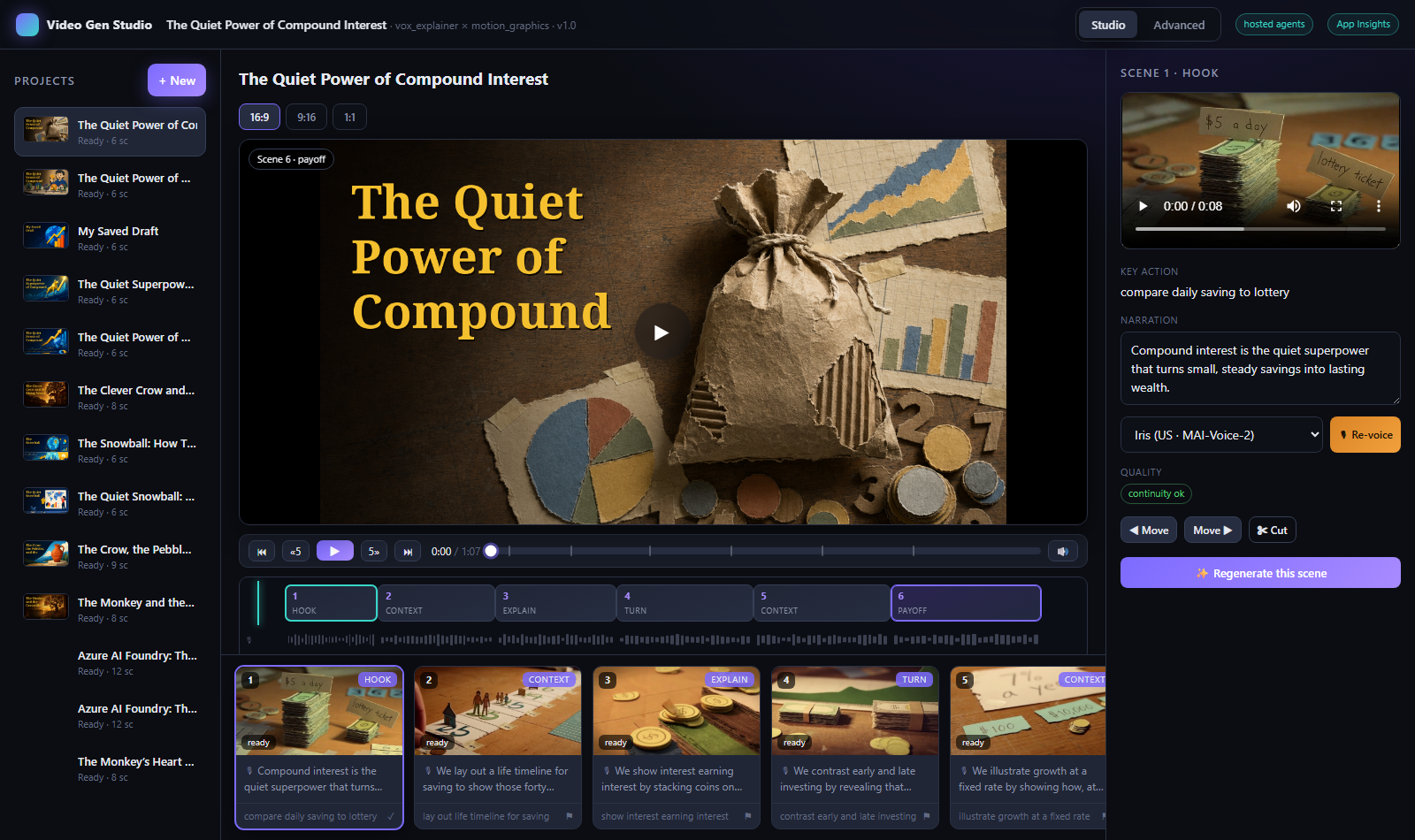
The storyboard it wrote
From that one sentence, ScriptWriter produced this — six beats, one crisp spoken line each (12–17 words, tuned so the voice fits the shot):
| # | Beat | Narration it wrote |
|---|---|---|
| 1 | hook | Instead of babysitting brittle servers, imagine your AI agent lives in the cloud and just works. |
| 2 | context | Building agentic apps is hard because wiring models, tools, scaling, and security quickly turns into spaghetti. |
| 3 | explain | With hosted agents, you define the agent’s instructions, tools, and model like dropping modules into place. |
| 4 | turn | Then Azure hosts that agent server-side, lifting it into the cloud so infrastructure disappears from your plate. |
| 5 | context | Azure handles scaling, monitoring, and secure resource access with managed identity, wrapping your agent in guardrails. |
| 6 | payoff | Your team ships reliable agentic apps that just call a hosted agent, without running any orchestration yourselves. |
And then Sora-2 rendered each line as its own hand-made paper-craft shot:


Every scene moves — the pacing engineering
This is the part I’m proud of, and it’s why the film feels finished rather than generated.
Early cuts had a subtle disease: Sora renders a fixed-length clip, but a narration line is a different length. When the voice ran long, the studio froze the last frame and held it while the narrator kept talking. On an earlier six-scene film, 26% of the runtime was frozen — a third of every scene was a still image with a voice-over.
So the render pipeline now fits the clip to the voice: it estimates each line’s spoken length, picks the shortest Sora length that covers it, and trims the scene to end exactly when the narrator does. Same six scenes, measured with ffmpeg freezedetect:
| Earlier cut | This film | |
|---|---|---|
| Runtime | 71.9s | 41.0s |
| Per scene | 12.0s | 6.8s |
| Frozen held-frames | ~19s (26%) | 0.0s (0%) |
Shorter, snappier, and the picture moves the whole way through. No held frames, no dead air.
Made on Azure — by agents, hosted by Azure
The whole crew runs keyless on Azure with a single managed identity: Microsoft Agent Framework for the agents, Sora-2 for motion, gpt-image-2 for keyframes and reference locking, Azure AI Speech for the voice, gpt-4o vision for QA, and Azure Container Apps (VNet-integrated, deployed with azd) for the studio itself.
And the agents in this run executed on Azure AI Foundry’s hosted Agent Service — so the film about hosted agents was, fittingly, directed by hosted agents.
The best part: I never opened a video editor. I typed a sentence, approved a storyboard, and watched six scenes stream in. That’s the whole pitch — you direct; the crew builds.