
Sopāna: The Snakes & Ladders That Teaches (Moksha Patam, Reborn)
Sopāna reclaims Snakes & Ladders and restores its origin — the ancient Indian Moksha Patam, where every snake is a vice and every ladder a virtue. Land on one and it animates and reads its meaning aloud. Play across four worlds, in 2D, 2.5D, and 3D.
Part of the #AI4Good series — one app a day, each built for good.
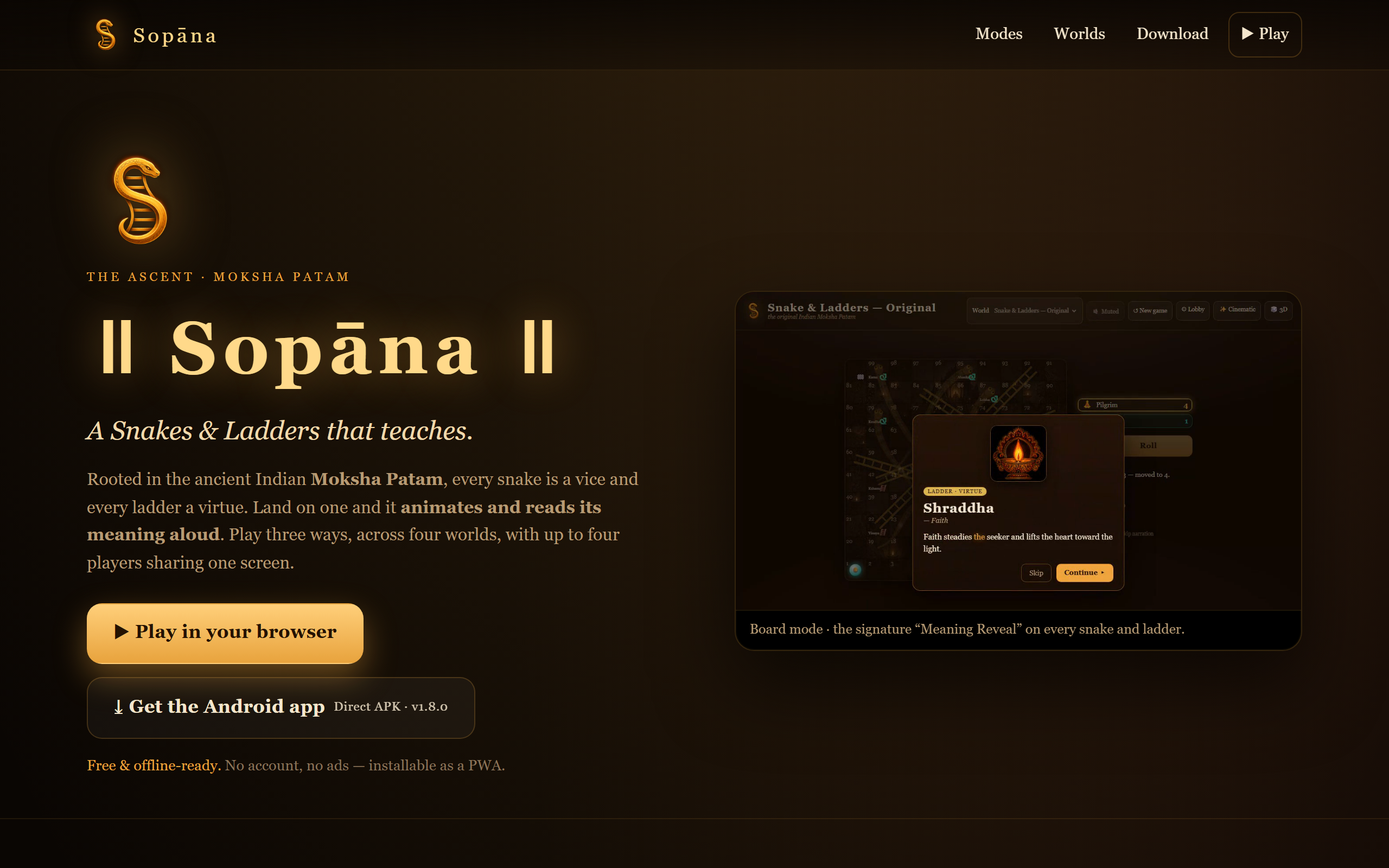
Before it was a plastic race to 100, Snakes & Ladders was Moksha Patam — an Indian teaching game where the board was a map of the soul. Somewhere along the way we kept the dice and threw away the meaning. Sopāna puts it back.
What it is
Sopāna is a Snakes & Ladders that teaches. Open it and you land in a lobby — pick a theme, a mode, 1–4 players and a character for each, then play local pass-and-play multiplayer. The same game is drawn three ways:
- Board — a crisp 2D board with a live turn roster, animated themed snakes & ladders, and coloured tokens.
- Cinematic — a 2.5D backlit shadow-puppet ascent with a per-theme Sora-2 intro film and an adaptive procedural score.
- 3D — a real 3D board with an orbit camera (drag to spin, scroll to zoom), a themed environment and player-coloured pawns.
The signature is the Meaning Reveal: land on a snake or ladder and the board dims, the connector highlights, a themed card shows the name + one-line teaching, and a narrator reads it aloud with word-by-word highlight before your token travels. Four worlds ship — Moksha Path (vices vs virtues), Founder’s Climb (startup pitfalls vs wins), Panchatantra Trail (fables), and Habit Heroes (kids’ habits).
How it was built
Sopāna is radically data-driven: a new world is essentially one JSON file in web/worlds/*.json over a single pure rules engine (web/js/logic.js). Every snake/ladder is just { from, to, name, en, meaning }, and meaning is the line read aloud. The three renderers — Board, Cinematic (PixiJS), and 3D (Three.js) — all draw the same manifest, so content never lives in a renderer.
- Every asset is generated, per theme. Azure (AAD-only via
az login) drives it:gpt-image-2renders the board backdrop, the player figurine, and one illustration per snake/ladder in each world’s art style (Moksha = authentic Togalu Gombe leather shadow-puppet); Azure Neural TTS narrates each meaning (Moksha =en-IN-Arjun:DragonHDLatestNeural). Files follow a<type>-<from>.{png,mp3}convention the app loads automatically, falling back to the browser’s SpeechSynthesis when a clip is missing — andnpm testincludes an asset-sync check that every entry has matching art + narration. - The Cinematic mode is a little engine of its own (PixiJS + Web Audio): the pilgrim walks a winding staircase step-by-step (each step ignites), landing on a vice/virtue triggers an animated light-sweep or a serpent strike with screen-shake, the 100 steps span five lokas with curtain-wipe realm transitions, and a procedural raga (Bhūpāli) plays an ascending melody as you climb, over an adaptive drone that brightens per realm.
- Zero-dependency tests (
node:test) plus Playwright visual QA (tooling/shoot.mjs); shipped to GitHub Pages and an Android Capacitor APK (CI, JDK 21). Licensed PolyForm Noncommercial.
The good
Kids absorb values through play, not lectures. By restoring the why to every square — narrated, animated, and beautiful — Sopāna turns a car-trip game into a gentle lesson in ethics and consequence, and keeps a piece of cultural heritage alive. That’s #AI4Good.
Play it
- ▶️ Play in your browser: naveenneog.github.io/Sopana
- 📦 Download the APK: latest release
- 💻 Source: github.com/naveenneog/Sopana
Previous → The Lamp & the Machine · Next → Chaturanga. #AI4Good